
What Battery Range Should You Expect From a 2 Seater Golf Cart?
Start With the Distance You Actually Need
When people shop for a 2 Seater Golf Cart, they usually ask one version of the same question: how far will it go before I need to recharge or refuel? That is the right place to start, but range only makes sense when you tie it to your real routine. A cart used for nine holes on mostly flat paths has a very different job from one making neighborhood trips, carrying two adults, climbing long grades, and stopping every few minutes.
The mistake I see most often is buying around the biggest range claim instead of buying around the most demanding day. If your longest normal use is short and predictable, you do not need to chase the highest number. If your routes include hills, rough ground, or repeated trips without much downtime, a “good enough on paper” range can feel disappointing fast.
A practical way to judge a cart is to build your own checklist before you compare models.
Check the Range Claim the Right Way
Not all range claims are equally useful. Some are based on light loads, smooth pavement, steady speeds, and ideal temperatures. That does not make them false, but it does mean they may not match your use.
- Ask what battery type the claim is based on. Lead-acid and lithium setups behave differently in daily use, charging time, and voltage consistency.
- Look for the driving conditions behind the number. Flat resort property and hilly residential roads are not the same test.
- Check whether the figure assumes one rider or two. A 2 Seater Golf Cart carrying two adults all day will not perform like an empty cart.
- Find out whether accessories were included. Headlights, sound systems, fans, and other electrical add-ons draw power.
If a seller only gives a broad claim with no usage context, treat it as a best-case number, not your planning number.
Map Your Use Into Three Simple Buckets
Before comparing carts, sort your use into one of these patterns. This makes the range question easier to answer.
Most buyers do not need a lab-style number. They need confidence that the cart will finish a normal day without becoming something they have to constantly nurse back to the charger.
Battery Type Changes the Experience, Not Just the Spec Sheet
If you are choosing between battery options, this is where the decision gets real. Lead-acid batteries can still be workable for lighter duty and shorter routes, especially when charging access is easy. But they tend to lose their edge faster when carts are used heavily, left partially charged, or driven through repeated stop-and-go cycles.
Lithium batteries usually give a more stable driving feel across the charge cycle. That matters because a cart that technically still has power left can feel sluggish long before it is fully depleted. For a buyer focused on dependable daily range rather than lowest entry price, that difference is often more important than the headline number.
The quick check is simple: if your 2 Seater Golf Cart will be used often, by more than one driver, or for repeated trips where downtime is annoying, battery chemistry deserves as much attention as body style or seating comfort.
Do Not Ignore Terrain, Because Terrain Eats Range
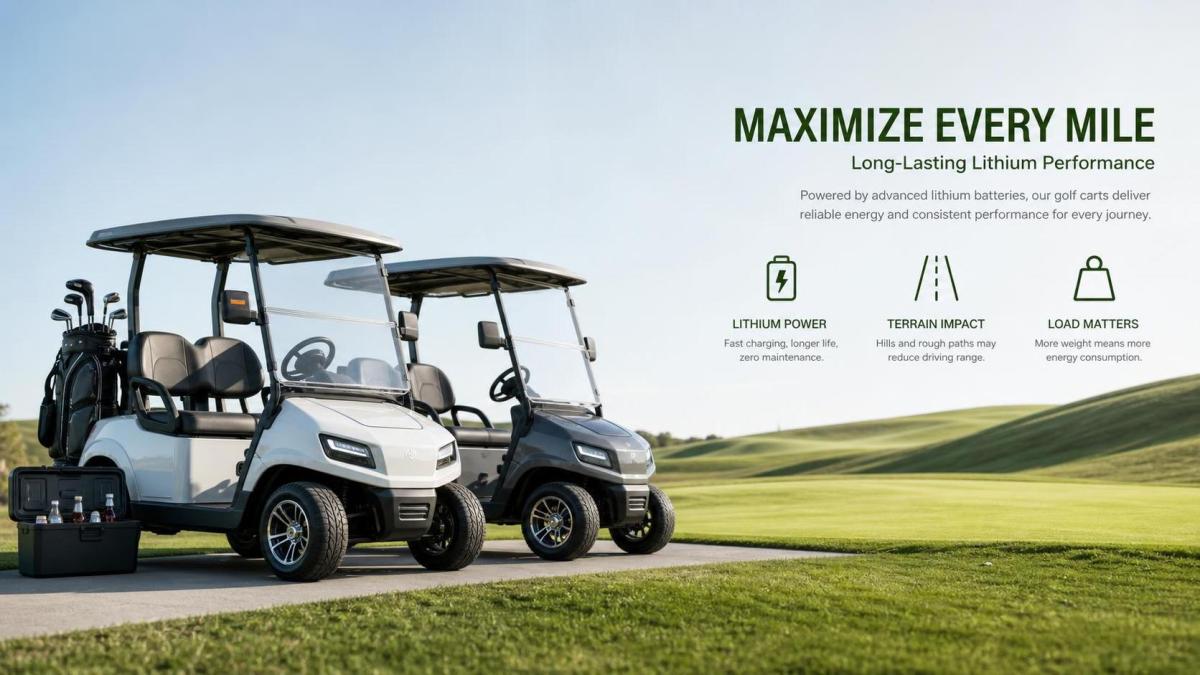
A flat gated community and a hilly campground can make the same cart feel like two different machines. Inclines increase current draw. Loose surfaces add resistance. Repeated acceleration out of corners or intersections does the same thing more quietly, but it adds up over a day.
Here is a practical rule: the more your route asks the cart to work, the less useful a best-case range claim becomes. If your path includes ramps, rough sections, or frequent climbing, build in margin. Do not shop for a cart whose published range only barely covers your intended use.
Passenger Load and Cargo Matter More Than Buyers Expect
People tend to think, “It only seats two, so weight cannot be a big factor.” It is. Two adults, a golf bag, a cooler, tools, or supplies change the load enough to affect distance and efficiency. Add hills and the difference becomes more noticeable.
If your normal use includes carrying more than just two light passengers, judge the cart based on loaded use. Not empty-cart use. That sounds obvious, but it is where many purchase decisions go wrong.
Think About Charging as Part of Range
Range is not only about how far the cart can travel. It is also about how easy it is to recover for the next trip. A buyer with overnight charging at home can live comfortably with less reserve than someone who uses the cart across a long property with little downtime between trips.
- Check where the cart will be parked most often.
- Measure whether charging will be routine or inconvenient.
- Consider whether more than one person will use it in the same day.
- Ask whether partial charging fits the battery system you are buying.
A cart with moderate range and easy charging can be a better fit than a longer-range cart that is awkward to recharge in your actual setup.
Use Driving Style as a Reality Check
Range is not consumed evenly. Drivers who accelerate hard, run at top speed whenever possible, and make lots of short stop-start movements usually get less useful range than buyers expect. Smooth driving stretches battery life. Constant bursts shorten it.
That does not mean you need to drive cautiously all the time. It just means your habits should be part of the decision. If the cart will be shared by family members or staff, assume a less-than-perfect driving pattern when you evaluate expected distance.
A Quick Filter for Comparing Models
When comparing options, I would narrow the list with this sequence:
- Write down your longest normal day of use, not your shortest.
- Add in your real load: two riders, bags, tools, or cargo.
- Mark how much of the route is hilly, rough, or stop-and-go.
- Decide whether charging access is easy, occasional, or inconvenient.
- Only then compare the stated range and battery type.
If a model still looks comfortable after that filter, it is probably worth your time. If it only works under ideal assumptions, keep looking.
Keep Similar Vehicles in Perspective
Sometimes it helps to compare categories, even if you are fixed on a two-seat layout. For example, a larger people-mover such as 23 srats open sightseeing cart belongs to a very different use case, but it highlights an important buying principle: once passenger count, vehicle size, and operating demands rise, the power system has to be matched more carefully to route length and duty cycle. The same logic applies on a smaller scale when you choose a 2 Seater Golf Cart for more than casual leisure use.
Common Buying Mistakes That Lead to Range Regret
- Buying for flat-ground performance when your property is not flat.
- Assuming one short test drive reflects a full day of use.
- Ignoring accessories and add-ons that increase power draw.
- Treating the stated range as the distance you will always get.
- Focusing on purchase price while overlooking battery replacement and charging convenience.
Most of these are easy to avoid if you evaluate the cart in terms of your weekly routine, not the sales sheet alone.
What a Sensible Buyer Should Do Next
If you want a useful expectation for battery range, start with your route, your load, and your charging setup. Then read any published distance claim as a condition-based estimate, not a promise. For most consumers, the best choice is not the cart with the biggest headline number. It is the one that can cover your normal day with some buffer left when the path is steeper, the load is heavier, or the driving is less gentle than planned.
That is the standard worth using when you shop for a 2 Seater Golf Cart: enough range for your real life, not just enough range for a brochure.
Related Posts
Online Message
Get in Touch
*We respect your confidentiality and all information are protected.