
Utility Golf Cart Buying Guide: Key Specs, Payload, and Total Cost to Compare
Multi-functional golf cart
Choosing a Utility Golf Cart is rarely a simple price comparison. For procurement teams, the real question is whether the vehicle can handle daily workloads without creating hidden operating costs, downtime, or replacement pressure two years later. A cart that looks competitive on a quotation sheet may turn out to be underpowered for hilly sites, oversized for narrow paths, or too lightly built for repeated cargo movement.
That is why the most useful buying comparison starts with work requirements, not brochure claims. Procurement needs to translate site conditions, payload expectations, maintenance resources, and usage intensity into a practical specification set. When that step is skipped, buyers often end up choosing between models that were never truly comparable in the first place.
This guide looks at the key factors that matter most when comparing a Utility Golf Cart for grounds work, internal transport, hospitality operations, campuses, industrial facilities, and commercial properties. The goal is not to identify the “best” cart in general, but to help buyers determine which specification mix produces the lowest risk and the most defensible total cost over the service life.
Start with the job profile, not the catalog category
Many procurement mistakes begin with a vague internal request such as “we need two utility carts for site transport.” That description is too broad to support a sound purchase. A light-duty cart moving tools across flat resort grounds has very different requirements from a vehicle used for maintenance rounds in a warehouse park, or for hauling supplies across a large campus with gradients and mixed surfaces.
Before comparing models, buyers should pin down a few operating facts:
What is the typical load, and what is the heaviest realistic load? How many trips will the cart make per shift? Will it operate on paved paths only, or on gravel, turf, and uneven service roads? Are there ramps or slopes? How much idle time is available for charging or maintenance? Will the unit be used by one trained team or many rotating operators?
Those answers shape the specification far more than brand positioning does. In practice, a Utility Golf Cart should be treated as a work vehicle with a defined duty cycle, not as a generic mobility platform. Once procurement defines that duty cycle, the shortlist becomes much more rational.
Payload is the first number buyers should challenge
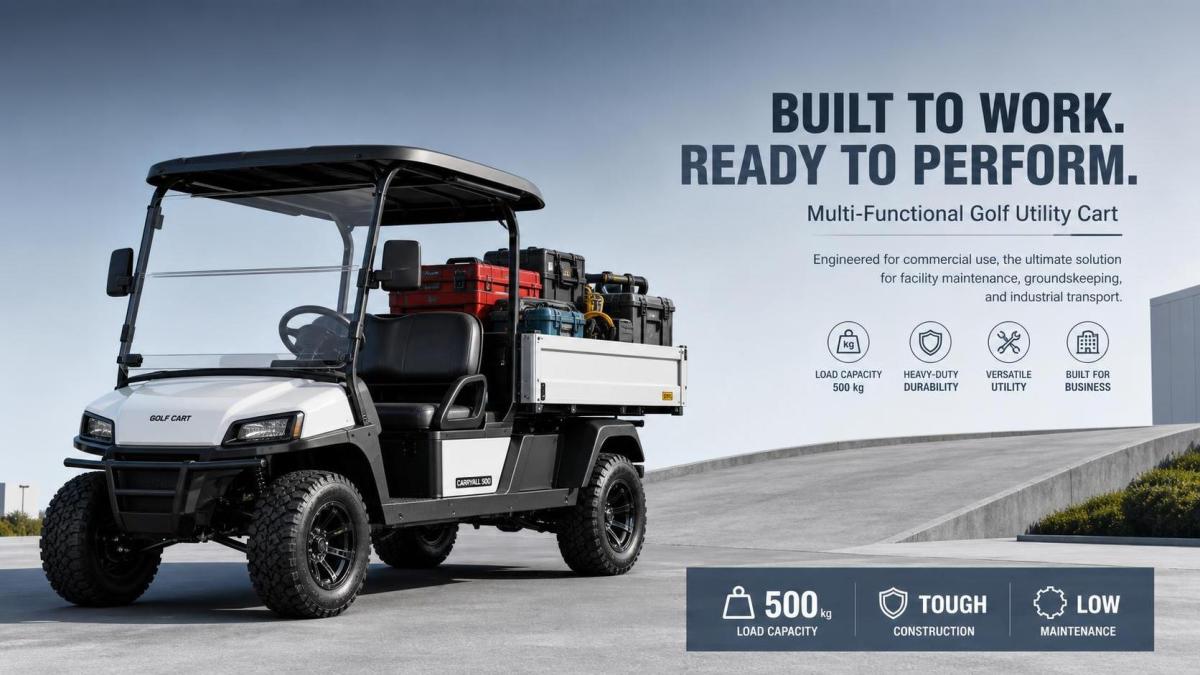
Payload claims are among the most misunderstood numbers in this category. Buyers often focus on passenger count or bed size, while the real limit on usefulness is how much weight the cart can carry safely and repeatedly. A cart that looks spacious may still be a poor fit if its suspension, frame, braking setup, or motor output is designed for lighter intermittent use.
When reviewing payload data, ask suppliers to clarify exactly what the rating includes. Some figures may refer only to cargo bed capacity, while others represent total vehicle load including passengers, tools, and accessories. That distinction matters. A maintenance crew carrying two operators, equipment, and replacement parts can exceed a practical working limit long before the cargo box appears full.
Procurement should also distinguish between occasional maximum load and normal operating load. If a cart is routinely used near its upper payload threshold, wear rates on tires, brakes, batteries, and suspension components will typically rise. This pushes up lifecycle cost even if the vehicle meets the specification on paper.
For most buyers, the safer approach is to leave operating headroom. A model that can carry the expected daily load with margin will usually perform better over time than a lower-cost unit chosen at its nominal maximum.
Powertrain choice affects cost structure more than purchase price suggests
In utility applications, the battery-electric versus gasoline decision is not only about energy source. It changes operating rhythm, maintenance planning, ventilation needs, noise levels, and site suitability.
Battery-electric carts are often preferred for resorts, campuses, municipalities, warehouses, and other environments where quiet operation and low local emissions matter. They usually have lower routine maintenance requirements because there is no engine oil, fuel system, or exhaust servicing. For buyers managing indoor or semi-enclosed environments, electric platforms are often the more practical choice.
That said, electric cost advantages depend heavily on battery chemistry and charging discipline. Lead-acid systems may have lower upfront cost, but replacement cycles, watering requirements, charging behavior, and performance degradation can materially affect operating economics. Lithium battery systems usually cost more at purchase, yet they may reduce maintenance burden, improve usable runtime stability, and shorten charging downtime. Whether that premium is justified depends on vehicle utilization. For a lightly used cart, lithium may not deliver a compelling payback. For multi-shift or high-frequency use, it often deserves serious consideration.
Gasoline utility carts remain relevant where long runtime, fast refueling, remote operation, or limited charging infrastructure are key constraints. They may also suit mixed-terrain sites where sustained torque demand and distance between use points make charging less convenient. But buyers should calculate the full operational tradeoff: fuel handling, engine servicing, noise, emissions constraints, and the possibility of future site policy changes around combustion equipment.
In other words, procurement should not ask which powertrain is cheaper to buy. It should ask which one fits the operating pattern with the least friction over three to five years.
Range, runtime, and charging windows need realistic interpretation
Supplier range claims are often based on controlled conditions that do not reflect loaded utility use. Payload, stop-start driving, slopes, temperature, surface conditions, and accessory loads all reduce effective runtime. A cart used for security patrol on paved flat roads may perform very differently from the same model carrying irrigation tools across a large property.
For electric models, the useful procurement question is not “What is the maximum range?” but “Can the cart complete a real shift without disrupting operations?” That requires examining daily mileage, idle periods, charging opportunity, and whether battery performance declines under repeated partial-charge cycles.
Buyers should also ask about charger type, charging time, voltage requirements, and whether the site electrical setup can support fleet expansion. A low vehicle price can become less attractive if new circuits, charging bays, or power management changes are required. Infrastructure cost belongs in the acquisition model, not as an afterthought.
Where suppliers provide a broad selection of golf carts, procurement teams should avoid comparing runtime figures across different configurations without checking battery size, controller setup, tire type, and expected load assumptions. Seemingly similar models may be optimized for entirely different duty profiles.
Durability depends on frame, suspension, brakes, and environment fit
Procurement teams sometimes underestimate how quickly site conditions expose weak construction. A Utility Golf Cart used on smooth paths for guest support can tolerate a different build standard from one used by facilities teams carrying tools over curbs, uneven service lanes, or wet grounds.
Durability assessment should include frame material and corrosion resistance, suspension design, brake configuration, axle strength, tire suitability, and protection of electrical components from dust and moisture. In coastal or humid environments, corrosion protection becomes especially important. In industrial settings, impact resistance and ease of parts replacement often matter more than cosmetic finish.
Accessory demands should also be factored in early. Tool racks, enclosed cabins, cargo boxes, ladder holders, tow hitches, lighting packages, and weather protection all influence vehicle weight and performance. Buyers sometimes approve a base specification and only later discover that the installed accessory set changes center of gravity, payload margin, or battery runtime.
This is also where procurement should ask hard questions about what is standard and what is optional. Two quotations can look close until one includes heavy-duty suspension, upgraded brakes, and site-ready lighting while the other does not.
Total cost of ownership is usually decided by replacement cycles and downtime
For procurement, total cost of ownership is more useful than unit price because it captures the cost drivers that create budget pressure after delivery. In this segment, the main cost elements typically include acquisition price, freight, import duties where applicable, commissioning, charging infrastructure, energy or fuel, preventive maintenance, battery replacement, tire and brake wear, spare parts availability, labor cost for repairs, and residual value.
Battery replacement is often one of the biggest variables for electric fleets. If the expected battery life is unclear, buyers should request usage assumptions behind the estimate and ask whether warranty terms are prorated or full coverage. A low upfront offer becomes less competitive if battery replacement arrives earlier than anticipated.
Downtime cost should also be treated as a financial metric, even if it does not appear directly on the supplier quote. If the vehicle supports maintenance teams, housekeeping, grounds crews, or internal logistics, an unavailable cart can delay labor and reduce service responsiveness. Procurement should therefore assess spare parts lead times, local service support, technician training needs, and whether common wear parts are stocked regionally.
In some cases, a slightly higher-priced model delivers better economics simply because it is easier to maintain and less likely to sit idle waiting for imported components.
Supplier reliability matters as much as vehicle specification
A technically suitable cart is still a weak procurement decision if the supplier cannot support delivery consistency, parts continuity, or after-sales communication. This is particularly relevant in cross-border sourcing, where the headline factory capability may look strong but practical support depends on documentation quality, export experience, and post-sale responsiveness.
Buyers should verify production lead times, minimum order terms, packaging methods, spare parts policy, warranty process, and availability of technical manuals and parts lists in usable English. If the purchase is for fleet deployment, ask whether the supplier can maintain configuration consistency across repeat orders. Component substitutions between batches can complicate maintenance and inventory planning.
Certification and compliance should also be checked carefully. Requirements vary by market and use case, and some claims need validation rather than assumption. If road legality, battery transport compliance, or site-specific safety requirements are relevant, procurement should request documentation and mark any unconfirmed item as 【待核实】 until verified.
Common buying errors usually come from underestimating usage intensity
One common error is buying for average use instead of peak use. If carts are selected based on normal days but operations depend on them during event periods, seasonal workload spikes, or high-occupancy weeks, the fleet may become a bottleneck exactly when reliability matters most.
Another mistake is comparing carts as if all utility models were equivalent once they have a cargo bed. In reality, differences in motor output, battery setup, chassis strength, and braking design can materially affect suitability. A lower-priced model may still be reasonable for light-duty hospitality support, but it may be the wrong asset for maintenance-heavy operations.
Procurement teams also sometimes separate vehicle buying from site operations too completely. The best results usually come when purchasing, maintenance, and end users align on what the cart actually needs to do. Feedback from facilities managers, grounds supervisors, and service technicians can prevent specification gaps that are expensive to correct after delivery.
How to build a stronger comparison model
A practical sourcing process is to score shortlisted carts against a limited set of weighted factors: real payload margin, runtime fit for the shift, maintenance burden, infrastructure impact, durability for surface conditions, supplier support, and estimated three-to-five-year cost. That approach tends to produce better decisions than broad feature checklists.
It is also worth separating “required” from “desirable” specifications. Required items might include minimum payload, gradeability, charging compatibility, service documentation, and parts availability. Desirable items may include enclosure options, upgraded seating, or premium finishes. This keeps the evaluation grounded in operational value rather than presentation.
When reviewing an offer for golf carts, buyers should request a configuration-specific quotation and not rely on a base-model price as the decision benchmark. The meaningful comparison is the delivered cost of a unit that is actually ready for the intended job.
The best purchase is the one that stays useful under routine pressure
A Utility Golf Cart earns its value through daily reliability, not through a low acquisition figure alone. Procurement teams that define the workload clearly, challenge payload and runtime assumptions, and model maintenance and replacement costs usually make better long-term decisions than those relying on catalog comparison.
In this market, the strongest buying position comes from understanding where operating demands will expose weak specification choices. If the cart can carry the real load, complete the real shift, survive the real environment, and be serviced without disruption, the purchase case is usually sound. That is the standard worth applying before price becomes the deciding factor.
Related Posts
Online Message
Get in Touch
*We respect your confidentiality and all information are protected.